List of Fake Crypto Trading Websites: Named Cases and 8 Checks
No complete list of fake crypto trading websites exists, and any page claiming to have one is out of date the day it is published: scam platforms change names, domains and apps faster than anyone can catalogue them. What does exist is a record of platforms that US regulators and federal courts have named, and a short set of checks that catch the rest. Below are six platforms named by the CFTC, the SEC or a federal judge, each with its source, followed by eight checks to run before you deposit a cent.
Read this first if someone you met online, in a group chat or on a dating app is guiding you to a trading site or app, or if a platform is asking you to pay a fee or tax before you can withdraw. That second sign alone is enough: in the FBI's account of crypto investment fraud, being charged 'taxes and fees' to withdraw is the final stage before the scammers disappear.
Short answer: verify on a regulator register before depositing
A list of names can only tell you about yesterday's scams. The check that works on tomorrow's is the reverse: confirm that the platform is registered or licensed with a regulator where you live, on the regulator's own website, before you send anything. If you cannot find it there, or the only proof is a licence image the platform sent you, do not deposit. The SEC's case against Morocoin, Berge and Cirkor, below, alleges that all three falsely claimed to hold government licences.
The second rule is about how you found the platform. Legitimate exchanges do not recruit customers through strangers who text a wrong number, befriend you on a dating app, or run an investment club in a messaging group. If the platform came to you through a person, treat it as fake until a register proves otherwise.
Fake platforms that regulators and courts have named
These names come only from US regulator press releases and court orders. Two distinctions matter. Where a court has ruled, we say so; where the SEC has filed a complaint, the claims are allegations that have not been proven in court. And a name missing from this table tells you nothing: fake platforms are routinely relaunched under new names and domains.
| Platform | Named by | What the regulator said | Status |
|---|---|---|---|
| Debiex (debiex.com, debiex.net) | CFTC; US District Court, District of Arizona | A 'bogus digital asset platform' whose websites mimicked a live trading platform; no trading took place. The complaint alleged about $2.3M taken from about five customers via romance-style solicitation; the court found over $2M misappropriated. | Default judgment 13 Mar 2025: liable for fraud; over $2.2M restitution and a $221,466 penalty |
| Aipu Limited and Fidefx Investments Ltd | CFTC; US District Court, Western District of Washington | A 'fake commodity trading platform': identical websites under different names, false account statements, solicitors on WeChat, WhatsApp and Line; took cash and digital assets. At least $3.6M taken. | Default judgment 22 May 2025: $13,863,170 penalty and $4,621,056 restitution, jointly |
| Morocoin Tech Corp. | SEC complaint, District of Colorado (filed 22 Dec 2025) | Alleged fake crypto trading platform that falsely claimed government licences; investors allegedly charged advance fees to withdraw. | Allegations in an SEC complaint, not proven in court |
| Berge Blockchain Technology Co. Ltd. | Same SEC complaint | Alleged fake platform in the same scheme. | Allegations |
| Cirkor Inc. | Same SEC complaint | Alleged fake platform in the same scheme. | Allegations |
The SEC complaint also names four so-called investment clubs it says fed victims to those platforms through WhatsApp groups promoted with social-media ads: AI Wealth Inc., Lane Wealth Inc., AI Investment Education Foundation Ltd. and Zenith Asset Tech Foundation. According to the SEC, the clubs offered supposedly AI-generated tips before steering members to Morocoin, Berge and Cirkor, and the scheme took at least $14 million from US investors between January 2024 and January 2025.
Searching for a broader list of fake crypto exchanges will turn up long community-compiled lists. Some are useful leads, but they are unverified and often stale. The closest thing to an official list in the US is California's DFPI Crypto Scam Tracker, which DFPI compiles from complaints it receives and sorts by scam type; a name there reflects a complaint, not a finding. The CFTC's RED List is different again: it names foreign firms that appear to need CFTC registration and do not have it, and the CFTC says a listing does not mean it or a court has found a violation.
How fake platforms work: the pig-butchering script
Regulators call it pig butchering, after the scammers' own term for fattening a victim before the slaughter. A CFTC advisory issued ahead of Valentine's Day 2024 and the agency's complaints describe the same sequence again and again, and the FBI's 2025 report says crypto investment fraud is largely run by criminal enterprises in Southeast Asia using trafficked forced labour.
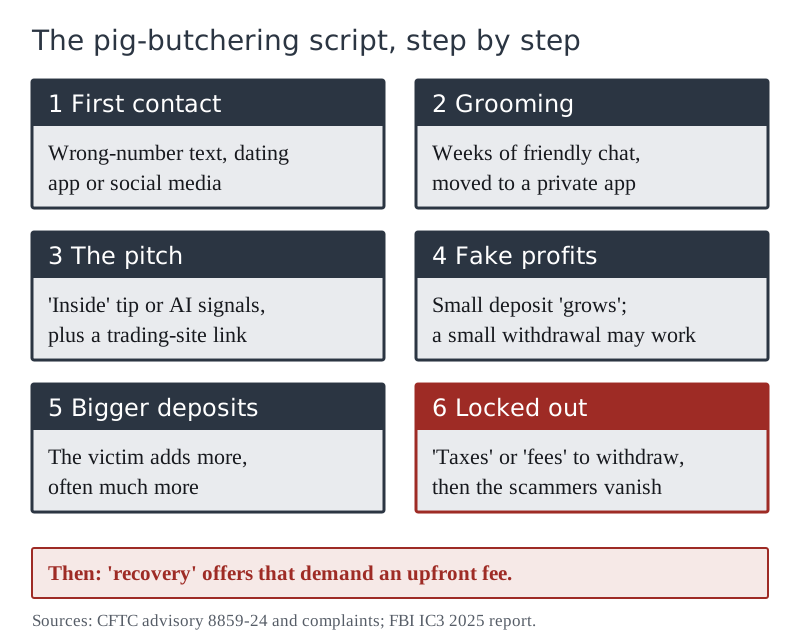
Two stages explain why intelligent people lose large sums. In stage 4, the fake site displays climbing profits and sometimes pays out a token sum, which the CFTC says is used to encourage you to invest more. That successful withdrawal is part of the script, not proof the platform is real. In stage 6, the 'fees' and 'taxes' arrive only when you try to take out the larger balance, by which point you have every reason to believe the money is there.
The SEC case shows a variant built around group chats rather than romance: ads on social media lead into a WhatsApp 'investment club' where, the SEC alleges, supposedly AI-generated tips won members' confidence before they were steered onto the same platforms. California's DFPI describes the same investment-group pattern, including fake members and bots that make a chat look busy.
How big the losses are
The FBI's Internet Crime Complaint Center (IC3) counts what victims report, which is only part of the real total. Even so, losses reported for crypto investment fraud have risen every year.
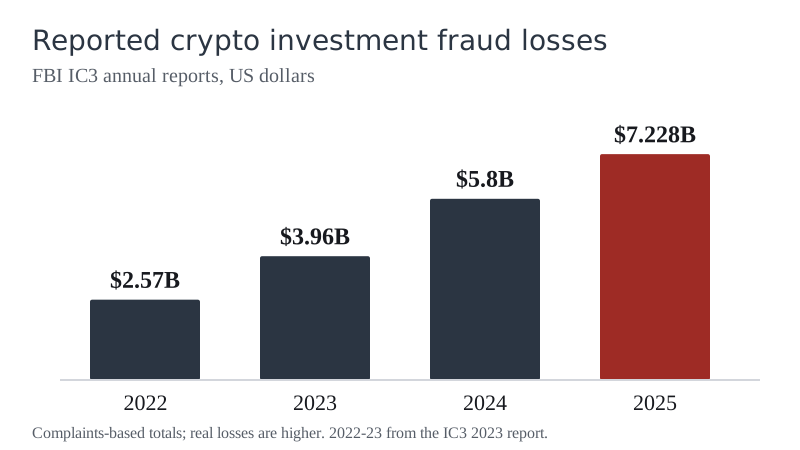
In 2025 crypto investment fraud was the largest source of reported losses to Americans: 61,559 complaints and $7.228 billion. Victims aged 60 or older accounted for $2.76 billion of that total. Across every crime type with a crypto link, the IC3 counted 181,565 complaints and $11.366 billion in losses, an average of $62,604 per complaint.
8 checks before you deposit
None of these checks is perfect on its own. Together, they stop almost every version of the script above, because a fake platform cannot pass the first three.
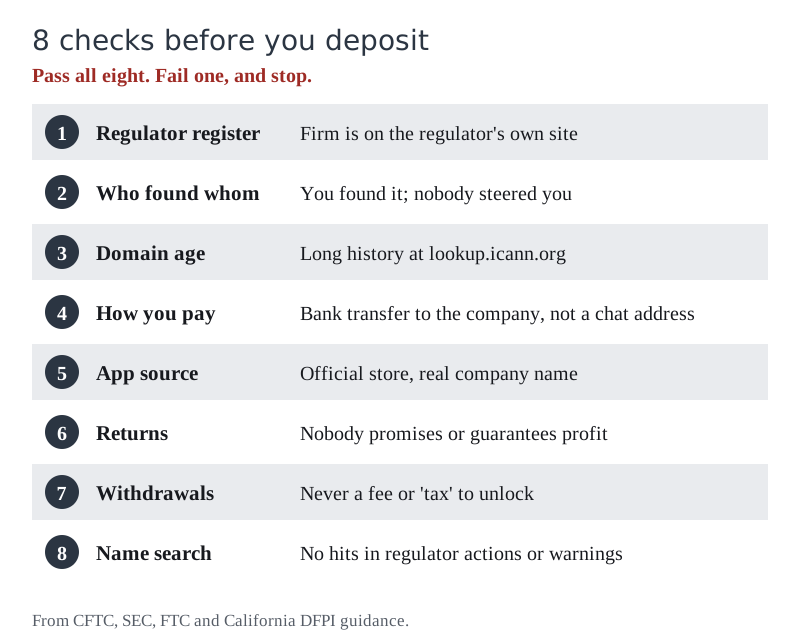
- Register check. Look the firm up on the regulator's own site, not through a link the platform gives you. In the US: the CFTC's registration check at cftc.gov/check, the SEC's Investor.gov and FINRA BrokerCheck, your state regulator and, for New York, the register of firms NYDFS has licensed for virtual-currency business. In the EU, ESMA's register of MiCA-authorised crypto firms; in the UK, the FCA register and its Warning List.
- Who found whom. If a person steered you to the platform, especially someone you have never met, stop. The CFTC's first warning sign is a new online contact who wants to move the conversation to a private messaging app.
- Domain age. The CFTC suggests checking how long a trading website has been registered at lookup.icann.org. Debiex's domains were created around 12 March 2022, the same month the CFTC says the scheme began.
- How you pay. A platform that accepts only crypto, sent to a wallet address someone gives you in a chat, is a CFTC warning sign. Regulated exchanges take bank transfers into accounts in the company's own name.
- Where the app comes from. Install exchange apps only from the official app store listing under the real company's name. A link to a download page, a test build or a file is a reason to stop.
- Promised returns. The FTC puts it simply: only scammers guarantee profits or big returns.
- Withdrawal terms. If any withdrawal requires you to pay first, whether called a tax, a fee, a deposit or a verification charge, treat the platform as fake.
- Name search. Search the platform's name with 'CFTC', 'SEC' or 'scam', and check the DFPI tracker. A hit is a red flag; no hit proves nothing.
A note on the 'withdrawal test' people often recommend: withdrawing a small amount first is worth doing, but it proves little. Fake platforms sometimes pay out small sums precisely to win a larger deposit. The register check is the one that matters.
Where to search: SEC, CFTC RED List, FCA and state regulators
Each register answers a different question, so use more than one. The CFTC's check tool and RED List cover firms offering futures, forex and other commodity products; the RED List names unregistered foreign firms, and the CFTC warns that a firm's absence from the list does not make it legitimate. The SEC's Investor.gov and FINRA BrokerCheck cover people and firms selling securities. California's DFPI Crypto Scam Tracker draws on consumer complaints and groups them by scam type, from fraudulent trading platforms to investment-group and recovery scams.
For exchanges, licensing is set mostly by states. New York publishes the firms it has licensed for virtual-currency business; on 9 Oct 2026 that list included Coinbase, Gemini, Robinhood Crypto, PayPal and Block. In the EU, ESMA's interim register lists crypto firms authorised under MiCA, and on 9 Oct 2026 it included Coinbase's and Kraken's EU entities. UK readers should search the FCA register and the FCA Warning List on fca.org.uk directly. Being registered is not a guarantee of good conduct, but not being registered anywhere is decisive.
Red flags in apps and websites
Fake platforms copy the look of real ones, so design is no guide. The CFTC's Debiex release says the websites merely mimicked a live trading platform, and the Aipu and Fidefx sites were identical but ran under different names. What gives them away is behaviour. Customer support exists only in a chat app. The 'license' is a picture. Deposits go to a personal-looking wallet address that changes. The platform has no history before a few months ago. And the people who recommended it get anxious or angry when you mention checking a regulator.
Fake wallet screens are the same trick in another form. Any balance a scammer controls can be made to show any number: a dashboard, a 'wallet' app, a screenshot of a transfer, or a spreadsheet of trades. A balance is real only if it sits in an account at a regulated firm in your own name, or in a wallet whose keys only you hold. Our guide to how trading platforms make money explains what a legitimate platform's business looks like, which helps when something feels off.
Lost money? What to do, and the recovery-scam trap
Stop sending money, including any 'fee' to release your balance. Then report quickly, because frozen funds are sometimes recoverable while they are still moving:
- File a complaint with the FBI at ic3.gov, with every wallet address, transaction ID, website and username you have.
- Report to the FTC at reportfraud.ftc.gov, and to the CFTC at cftc.gov/complaint if the platform offered crypto or forex trading.
- Tell the exchange or bank you sent money from, so it can flag the receiving accounts.
- Keep chat logs, screenshots and emails; do not delete the conversation.
Expect a second approach. Recovery scams generated 10,516 IC3 complaints in 2025, with $1.4 billion lost; in these, someone promises to get your crypto back for an upfront fee. Some even pose as government agencies. The IC3 states that it does not reach out to victims asking for payment or personal details. Government orders do not guarantee repayment either: the CFTC notes that restitution orders may not recover any money if the wrongdoers lack the funds.
If you still want to trade crypto
The safe version starts from a platform you can verify yourself. As examples, Coinbase has held a New York virtual-currency licence since January 2017 and its Luxembourg entity is MiCA-authorised, while Kraken's Irish entities appear on ESMA's MiCA register; you can check both on the regulators' sites before opening a Coinbase account or a Kraken account. Even on a real exchange, trading is risky and the odds favour the platform over the active trader; our platform comparison and the case on why day trading usually fails are worth reading first.
Edge cases
- The platform uses a real company's name. Clone sites copy registered firms' names and details. Reach the firm through the address on the regulator's register, not the one you were sent.
- The person is real and you know them. Hacked accounts are used to recommend fake platforms to friends. Confirm by phone or in person.
- You already paid one 'fee'. Stop there. A second fee will follow; nothing paid so far makes the next payment more likely to work.
- The platform claims to be regulated abroad. Check that country's regulator site directly, then ask whether the firm is allowed to serve where you live.
Fake crypto trading websites: FAQ
Is there a list of fake crypto trading websites?
How can I tell if a crypto trading platform is fake?
Why do I have to pay taxes or fees to withdraw from a crypto platform?
Can a fake crypto wallet show a real balance?
Is it possible to recover money lost to a fake crypto platform?
Keep reading: the best crypto trading platforms, ranked on fees, security and custody, or, if you are new, crypto trading for beginners — risks first. None of this is financial advice.