Day Trading Crypto: Why It Usually Fails and What It Costs
Day trading crypto means opening and closing positions within the same day, often many times, to profit from short price swings. It usually fails. The evidence on retail day traders is grim, the trading costs are charged on every round trip whether you win or lose, and in the US every closed trade is a taxable event. A 2014 study of Taiwanese day traders found that fewer than 1% could predictably earn returns above the market after fees, and our worked example below shows exchange fees alone can add up to several times a small account each year.
This briefing is for anyone weighing whether to try, or wondering why their own attempt is going badly. If you are set on doing it anyway, the last sections cover the harm-reduction version. If you would simply like exposure to crypto, buying a little and holding it on a reputable spot platform from our platform comparison costs far less and avoids most of the traps below. Nothing here is financial advice.
Short answer: what the evidence and the arithmetic say
Two things make day trading crypto a losing proposition for most people, and neither depends on how clever the trader is. The first is cost: exchange fees, spreads and slippage are paid on every trade, and day traders make a lot of trades. The second is competition: short-term price moves are the home ground of market makers and automated firms with faster data and lower costs. Put those together and the average day trader starts every day behind and has to be right often enough, by enough, to climb back.
The research agrees. The largest dataset on day traders, from Taiwan, found that fewer than 1% earned reliable returns after fees. European regulators found that most retail accounts trading leveraged CFDs lose money. There is no clean public figure for crypto spot day traders, and we will not invent one, but nothing about crypto makes the costs smaller or the competition gentler.
What day trading crypto actually involves
A crypto day trader buys and sells the same coins repeatedly within a day, usually on an exchange's advanced interface rather than its one-tap buy button. Orders are either taker orders, which fill immediately against the order book and pay the higher fee, or maker orders, which rest on the book as limit orders and pay a lower fee if they fill. Most day traders use a mix, and market orders in a hurry are always takers.
Three things set crypto apart from stock day trading. The market never closes, so there is no natural end to the session and no break from the screen. Many venues push perpetual futures with high leverage alongside spot, which turns an ordinary losing day into a liquidation. And the cost of a trade varies enormously between a platform's simple buy screen and its pro interface, so two people making identical trades can pay very different amounts.
Costs compound with every trade
Start with the fee schedule, because it is the one cost you can read in advance. Kraken publishes its Kraken Pro spot fees: on 9 October 2026 the entry tier was 0.40% maker and 0.80% taker, falling with 30-day volume to 0.18% taker at $1 million and 0.10% taker at $10 million. Gemini ActiveTrader's entry tier on the same day was 0.60% maker and 1.20% taker. Robinhood's default routing charges no commission but earns through the spread; its own example, on its crypto order-routing help page with rates as of 15 June 2026, says that on a $100 buy with a 0.96% spread, Robinhood receives $0.95.
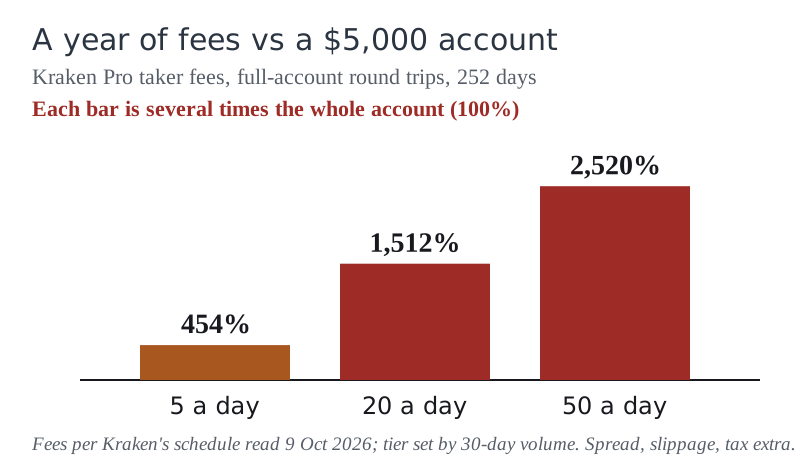
Now multiply. Take a $5,000 account that trades the whole balance in and out with market orders, on 252 days a year. Even after the trader's volume pushes them into Kraken's cheaper tiers, the taker fees on five round trips a day come to about $22,680 a year, 454% of the account. At twenty round trips a day the bill is about $75,600; at fifty, about $126,000. Those figures assume the account never shrinks, and they leave out the spread, slippage and tax.
| Scenario | 30-day volume | Fee tier (maker / taker) | Taker fees per year | Maker-only fees per year |
|---|---|---|---|---|
| $5,000 account, 5 round trips a day | $1,050,000 | 0.06% / 0.18% | $22,680 (454%) | $7,560 (151%) |
| $5,000 account, 20 round trips a day | $4,200,000 | 0.04% / 0.15% | $75,600 (1,512%) | $20,160 (403%) |
| $5,000 account, 50 round trips a day | $10,500,000 | 0.00% / 0.10% | $126,000 (2,520%) | $0 (0%) |
| $1,000 account, 5 round trips a day | $210,000 | 0.12% / 0.25% | $6,300 (630%) | $3,024 (302%) |
Two lessons sit in that table. First, smaller accounts pay proportionally more, because they never reach the cheap tiers: the $1,000 account above pays a larger share of its balance than the $5,000 one at the same trade count. Second, patient limit orders cut the fee bill sharply, and at very high volume maker fees can reach zero. That does not make the trader profitable. It moves the cost into the spread and into adverse selection, the habit of limit orders filling mainly when the price is about to move against them.
Think of fees as a hurdle the strategy has to clear before any profit counts. A holder pays the cost stack once. A day trader pays it hundreds of times a month, and the hurdle is charged on wins and losses alike. Our crypto trading fees explained briefing breaks the stack into its parts.
What the evidence says
The strongest study of day traders comes from Taiwan, where the exchange records let researchers follow every trader for years. Barber, Lee, Liu and Odean, publishing in the Journal of Financial Markets in 2014 with data from 1992 to 2006, concluded that "less than 1% of the day trader population is able to predictably and reliably earn positive abnormal returns net of fees." Those were equity day traders, not crypto traders, but the costs and the competition they faced are the same kind.
A working paper by Chague, De-Losso and Giovannetti followed Brazilians who day-traded mini-index futures for 300 days or more and reported that the overwhelming majority lost money. We could not read the paper's final figures on its host page this week, so we cite its conclusion rather than a percentage.
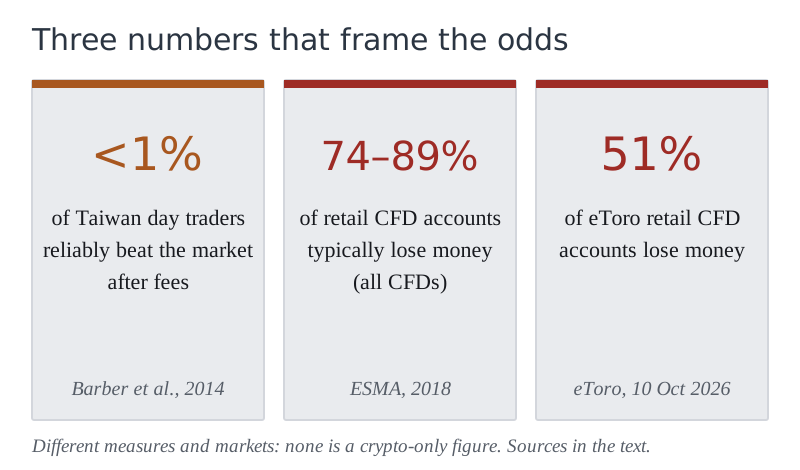
The leveraged-product data points the same way. When ESMA restricted CFDs for retail clients in 2018, it found that 74% to 89% of retail CFD accounts typically lose money, and it required every provider to publish its own loss rate. Those are not crypto spot figures, and the provider rate swings with market conditions, but they are the best regulator-collected outcome data available for retail short-term trading.
You are competing against professionals
Every trade has a counterparty, and in the short term that counterparty is often a market maker or an algorithm. They see the order book faster, pay lower fees or earn rebates, and do not get tired, bored or scared at 3am. Over minutes and hours, crypto price moves are close to a zero-sum contest before costs and a negative-sum one after them, so a retail trader's expected result is the average loss minus the costs they pay.
Early wins feel like skill but are mostly variance. A lucky first week encourages bigger positions and more trades, which raises the costs and the exposure just as the odds reassert themselves. The market is generous enough to beginners to keep them playing.
Psychology is the biggest leak
A market that never closes rewards impulse. Fear of missing out buys the top, panic sells the bottom, and the urge to win back a loss drives revenge trades with bigger size. Each is the opposite of what a written plan would do, and each adds trades, which adds costs.
Many people describe day trading in the language of compulsion: unpredictable rewards, a screen that is always on, and losses that are easy to call bad luck. If you notice that you are trading to feel something, or to recover what you lost yesterday, that is the signal to stop, not to adjust the strategy.
Leverage turns losses into ruin
Many crypto venues place leveraged perpetual futures beside spot trading, and day traders are their target audience. Leverage shortens the distance between an ordinary losing trade and a total loss: at 10x, a 10% move against you erases the margin. Funding payments and fees are charged on the full position but taken from the margin. Combine high frequency with high leverage and you stack the two habits most associated with blown-up accounts. Our spot vs margin vs futures briefing explains why we treat leverage as a warning, never a strategy.
Taxes for frequent traders
For US taxpayers, the IRS treats digital assets as property, and selling crypto, exchanging it for a different coin or using it to buy goods are all dispositions that can produce a capital gain or loss. A day trader can generate thousands of them a year, each needing a date, proceeds and cost basis. Gains on assets held one year or less are short-term, and the IRS taxes net short-term capital gains as ordinary income at graduated rates, which reach 37% at the top of the 2026 brackets.
Reporting has also tightened. US brokers must report gross proceeds on Form 1099-DA for digital-asset sales made on or after 1 January 2025, and must add cost basis for some of the sales made on or after 1 January 2026. The 2025 Form 8949 added digital-asset boxes, so a frequent trader's return can run to many pages. Losses help only so much: net capital losses offset other income by up to $3,000 a year ($1,500 if married filing separately), with the rest carried forward. Tax is a cost that grows with activity, and it lands after the trading year is over. See our crypto trading taxes briefing for the full picture; it is not tax advice.
Survivorship bias makes it look easier than it is
You hear from winners and sellers, rarely from the quiet majority who lost and stopped. Social feeds are full of profit screenshots and nearly empty of liquidations, though the second kind are far more common. Many of the loudest winners also sell courses or signal groups that pay them whether or not their method works; our briefing on trading bots and signals covers that trade. Correct for the invisible losers and the realistic expectation for a new day trader shifts from likely riches to likely loss.
If you refuse to be talked out of it
If you are going to try regardless, treat it as an expensive hobby with a fixed budget and a written exit rule. The harm-reduction version looks like this:
- Paper trade first for at least a month, logging every simulated fee. Our paper trading guide shows how, and most people's results stop them there.
- Fix the stake at an amount you could lose without affecting rent, debt payments or savings, and never top it up after a loss.
- Use limit orders where you can, because the published maker fee is about half the taker fee at Kraken Pro's entry tier.
- No leverage, no perpetuals, no margin, whatever the interface suggests.
- Keep a trade journal with fees and tax included, and stop if you are behind after a set number of weeks.
If you then want a venue, use the pro interface of a regulated spot exchange rather than its convenience buy button. Kraken publishes its Kraken Pro fee tiers (it does not serve New York or Maine), and Coinbase shows the fee and spread on its order preview before you confirm. Both also offer leveraged products this briefing tells you to leave alone. Choosing a cheaper venue lowers the hurdle; it does not remove it. Read managing risk if you trade before funding anything.
And be honest about motive. If the draw is the thrill or the hope of a life-changing win, those are the motivations most associated with the worst outcomes. For most day traders, the most profitable trade they will ever make is the decision to stop.
Edge cases
- "I only scalp stablecoin pairs." Price moves are tiny, so fees and spread are a larger share of any gain, not a smaller one.
- "My exchange has zero fees." Zero-commission venues are paid through the spread; Robinhood's own routing example shows about $0.95 per $100 bought.
- "I use a bot." A bot pays the same fees and spreads, often trades more, and a bot that reliably printed money would not be sold to you.
- Wash sales and trader tax status are technical areas where the rules for crypto and for securities differ; ask a qualified tax professional rather than relying on forum advice.
- Non-US readers face their own tax rules; in the UK, for example, HMRC treats swapping one cryptoasset for another as a disposal for Capital Gains Tax.
Risks and what can go wrong
The ways a day-trading account fails are well understood. Costs grind the balance down even when the win rate looks respectable. A run of losses triggers bigger, faster trades. Leverage converts one bad move into a total loss. A platform can freeze withdrawals or fail, as several did in 2022, so balances left on an exchange carry counterparty risk on top of market risk. And the tax bill can arrive for gains that were later lost. Crypto is volatile, you can lose all of your capital, past results do not predict future ones, and none of this is financial advice.
Common questions
What percentage of crypto day traders make money?
Is day trading crypto worth it?
What is the best crypto exchange for day trading?
Do crypto day traders pay tax on every trade?
Are there crypto day trading strategies that work?
Keep reading: the best crypto trading platforms, ranked on fees, security and custody, or, if you are new, crypto trading for beginners — risks first. None of this is financial advice.