Leverage Trading Crypto: The Liquidation Math, Explained
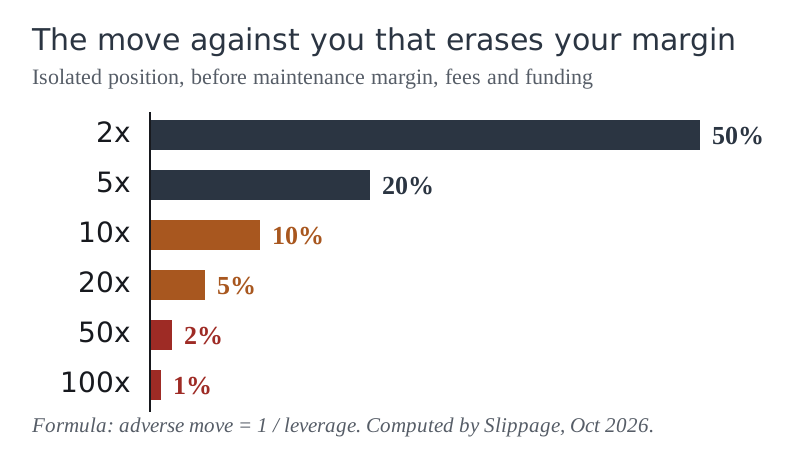
Leverage trading crypto means borrowing to hold a position bigger than your own money, and the price of that loan is a liquidation price: a level at which the venue closes your position and keeps the margin you posted. At 10x, a fall of about 10% in the coin erases a long position's margin; at 50x it takes about 2%; at 100x about 1%, and fees, funding and maintenance margin pull the real trigger closer still. That is the whole answer, and the rest of this briefing is the arithmetic and the rules behind it.
Who should read on: anyone who has been shown a "up to 100x" banner and wants to know what it actually means before touching it. Who should skip leverage entirely: almost every retail trader, including anyone who would be upset to lose the whole stake in an afternoon. If you already trade spot, our spot vs margin vs futures briefing covers the product differences; this one is about the numbers. Nothing here is financial advice.
Short answer: leverage magnifies losses, and small moves liquidate you
Leverage multiplies your exposure, not your skill. With 10x, every 1% move in the coin is a 10% move in your margin, in both directions. Gains are magnified, but so is the loss, and unlike a spot holding a leveraged position has a hard floor: when the loss eats through your margin, the position is closed whether or not the price later recovers. A spot buyer who is down 30% still owns the coin. A 10x long that met a 10% dip owns nothing.
That asymmetry is why we treat leverage as a warning. The question is never "how much could I make at 50x?" It is "how far does the price have to move against me before I lose everything I put in?" The chart below answers it.
How leverage and margin work
A leveraged position has three moving parts. The notional is the full size of the position, say $10,000 of bitcoin exposure. The initial margin is the part you put up yourself; at 10x that is $1,000, and the venue or the other side of the contract effectively provides the rest. The maintenance margin is the minimum equity the venue requires you to keep in the position; drop below it and the liquidation engine takes over.
Your equity in the trade is your margin plus or minus the running profit or loss on the full notional. On a $10,000 long, a 5% fall is a $500 loss, which is half of a $1,000 margin. A 10% fall is a $1,000 loss: the margin is gone. The venue does not wait for you to reach exactly zero, because it needs a buffer to close the position without losing its own money, so the forced close happens a little before that point. How much before depends on the venue's maintenance-margin rate and on any fees charged at liquidation, which differ by platform and by position size.
Margin trading on a spot exchange (borrowing coins or dollars against collateral) and perpetual futures (a contract that never expires) reach the same place by different routes. Margin loans charge interest; perpetuals charge funding. Both have a liquidation mechanism, and both turn a normal price swing into a permanent loss.
Liquidation price table
The simplest version of the maths, for an isolated position before fees, is that the adverse move which erases the margin equals one divided by the leverage. The table works through it on a $10,000 long and shows the price at which the margin is gone if the coin starts at $100,000. A short position mirrors it with a rise instead of a fall.
| Leverage | Your margin | Move that erases it | Coin price at that point | Loss if hit |
|---|---|---|---|---|
| 2x | $5,000 | 50% | $50,000 | $5,000 (all of it) |
| 5x | $2,000 | 20% | $80,000 | $2,000 (all of it) |
| 10x | $1,000 | 10% | $90,000 | $1,000 (all of it) |
| 20x | $500 | 5% | $95,000 | $500 (all of it) |
| 50x | $200 | 2% | $98,000 | $200 (all of it) |
| 100x | $100 | 1% | $99,000 | $100 (all of it) |
Now add the parts the headline leverage hides. A maintenance-margin requirement means the forced close happens before the margin reaches zero. A taker fee on the way in, and often a liquidation fee on the way out, is taken from the same margin. Funding on a perpetual is debited from it every interval you hold. Each of these shortens the distance in the table. At 50x or 100x, the entry fee alone can be a visible slice of the margin before the price has moved at all.
There is also a structural problem with the table: it shows the distance to liquidation from your entry, but prices do not move in a straight line. A position that ends the week up can still be liquidated on Tuesday by a wick that lasted minutes. Spot holders can sit through that. Leveraged traders cannot, which is why being right about direction is not enough.
The headline leverage tells you how much you control. The liquidation price tells you how little it takes to lose it.
Funding rates and fees
Perpetual futures have no expiry, so they need a mechanism to keep their price near the spot market. That mechanism is funding: at set intervals, traders on one side pay traders on the other. When the perpetual trades above spot, longs usually pay shorts; when it trades below, shorts pay longs. The rate floats with demand and can swing sharply, which means the cost of holding a position is not known in advance.
Here is the arithmetic with a rate chosen only to keep the numbers round, not quoted from any venue. If funding were 0.01% every eight hours, a $10,000 position would pay $1 per interval, $3 a day and $21 a week. On a 10x position backed by $1,000 of margin, that is 2.1% of your own money each week, before any price move. Over four weeks it is about 8.4% of the margin. Double the rate in a crowded market and you double those figures. Funding is charged on the notional, but it comes out of your margin, and that is the piece of the trade that is ten times smaller.
Trading fees work the same way. They are charged on the full notional, so a fee that sounds small is large relative to the margin. Kraken's published spot fee schedule, read on 9 October 2026, starts at 0.40% maker and 0.80% taker for the lowest volume tier; derivatives schedules differ, and every venue prints its own. Whatever the venue, check how its fee compares with your margin, not with the position.
Isolated vs cross margin
Most leveraged venues offer two ways to assign collateral. Isolated margin ring-fences a fixed amount for one position: if it is liquidated, you lose that amount and nothing else. Cross margin lets every position draw on the whole account balance: liquidation is pushed further away because there is more collateral behind the trade, but when it arrives it can take everything in the account, and a loser in one position can drag down the others.
The chart works through one account. You have $2,000 and open a $10,000 long. In isolated mode with $1,000 posted (10x on that slice), the position is closed after roughly a 10% fall and you keep the other $1,000. In cross mode, the full $2,000 backs the same $10,000 position, an effective 5x, so it survives until roughly a 20% fall and then takes the full $2,000.
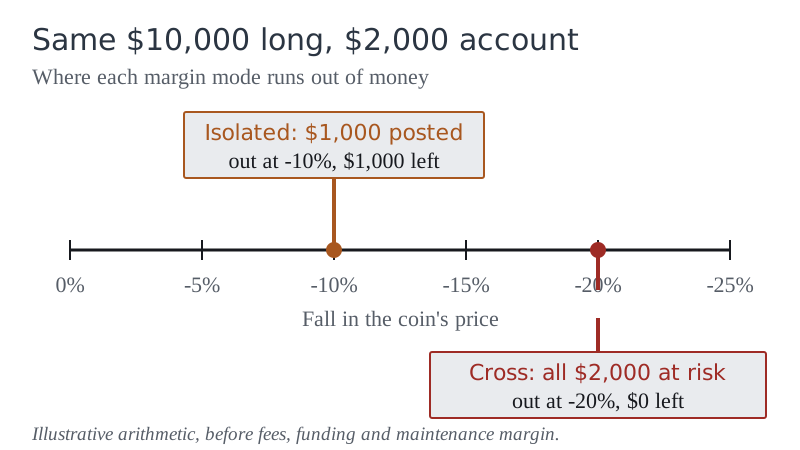
Neither mode is safe. Isolated caps the damage per position but liquidates sooner; cross delays liquidation by putting the whole account on the line. The practical risk with cross margin is behavioural: because the position survives the first dip, it is easier to keep adding to a loser until the entire balance is exposed. If a reader takes one rule from this section, it is that a margin mode is a choice about how much you are prepared to lose, and the honest answer for most people is less than either mode allows.
What's available to retail by region (dated)
Leverage rules for retail clients differ more by country than by platform. The table summarises what regulators' own pages said when we checked them on 9 and 10 October 2026. Rules change, and this is not legal advice.
| Region | What the rule says | Source |
|---|---|---|
| United Kingdom | Sale, marketing and distribution of crypto derivatives (CFDs, options, futures) to retail consumers banned since 6 January 2021. Separately, retail access to certain crypto exchange-traded notes was allowed again in October 2025. | FCA |
| European Union | ESMA's 2018 product-intervention measures capped retail crypto CFD leverage at 2:1, with a close-out when equity falls to 50% of required margin, negative balance protection and a standard loss warning. | ESMA |
| United States | Leveraged crypto futures are offered to US customers through CFTC-regulated firms; Coinbase's 2025 annual report says it now offers perpetual futures through its CFTC-registered futures commission merchant. The CFTC's RED list names foreign firms that appear to need registration but do not have it. | Coinbase, CFTC |
| Singapore | Licensed digital-payment-token providers should not offer retail customers credit, leverage or crypto derivatives (from 19 June 2025). | MAS |
Two notes on reading that table. First, the EU cap shows how regulators view the risk: at 2:1 the margin is half the position, and a close-out once equity falls to 50% of that margin shuts the position after a fall of about 25% in the coin. Even the most cautious regime in the table assumes a leveraged retail position can be forced shut. Second, "available" is not "suitable". A US platform can legally offer you leverage and still be the fastest way to lose money you cannot replace. Offshore venues advertising 100x to people in countries that restrict it are a separate problem; check the FCA or CFTC pages before depositing anywhere.
If what you want is exposure to crypto without a liquidation price, the plain route is spot: buy the coin outright on a regulated exchange, with money you could lose, and hold it in a way you understand. Our platform comparison covers the spot venues on fees, security and custody; Kraken (not available in New York or Maine) and Coinbase both offer spot trading to US customers, and both also sell leveraged products this briefing would steer you away from. Using either for spot does not remove the risk of the coin falling; it removes the risk of being closed out by a dip.
Why most leveraged traders lose
The best evidence comes from the regulated CFD market, because European rules force brokers to publish it. ESMA's 2018 analysis found that 74% to 89% of retail CFD accounts typically lose money, and every EU and UK CFD provider must show its own figure. eToro's international site, for example, displayed on 10 October 2026: "51% of retail investor accounts lose money when trading CFDs with this provider." Those numbers cover all CFDs, not crypto alone, and they come from markets that are calmer than crypto.
The mechanism is the one this briefing has walked through. Leverage shortens the distance to a total loss; fees and funding are charged on the full notional but paid from the small margin; and liquidation crystallises losses during temporary moves that a spot holder would ride out. Add the behaviour leverage encourages, such as sizing up after a win, adding margin to a loser, and trading more often, and the outcome data is unsurprising. The same pattern runs through our briefing on why day trading usually fails.
It is also worth noticing who earns when you use leverage. The venue collects fees on the full notional, the liquidation engine closes positions at prices that protect the venue, and the promoters who advertise high leverage are paid for sign-ups. None of them carries your downside. The size of the advertised multiple measures how small a move the product needs to take your stake, nothing more.
Edge cases and questions people forget to ask
- Stop-losses do not guarantee a price. In a fast market a stop can fill well below its trigger, and on a leveraged position that gap is magnified.
- Negative balances. EU retail CFD rules include negative balance protection; not every product or venue offers it. Check whether you can lose more than you deposit before you trade.
- Weekend and overnight moves. Crypto trades around the clock, so there is no closing bell to stop a slide while you sleep.
- Collateral that falls too. If your margin is posted in a volatile coin rather than dollars, a market drop shrinks your collateral and grows your loss at the same time.
- Taxes. In the US, futures and spot are taxed under different rules, and each closed trade can be a taxable event; our crypto trading taxes briefing explains the basics.
If you want to see how a leveraged position behaves without paying for the lesson, paper trade first and log every simulated liquidation. Most people who do that honestly stop there.
Risks and what can go wrong
Everything above comes down to five risks. You can lose the entire margin on a single move, and sometimes more. Funding and fees drain the position while you hold it. Liquidation happens at the worst price, often during a brief spike. Cross margin can turn one bad trade into a lost account. And regulation in your country may mean the venue offering you leverage is not authorised to serve you at all, leaving no protection if it fails or freezes withdrawals. Crypto is volatile, you can lose all of the capital you commit, and nothing in this briefing is financial advice. For the general rules we would apply to any trading at all, read managing risk if you trade.
Common questions
What is leverage trading in crypto?
How do I work out my liquidation price?
Is crypto margin trading legal in the US and UK?
Is isolated or cross margin safer?
What is the best crypto leverage trading platform?
Keep reading: the best crypto trading platforms, ranked on fees, security and custody, or, if you are new, crypto trading for beginners — risks first. None of this is financial advice.