eToro Copy Trading for Crypto: How It Works, What Can Go Wrong
eToro copy trading, sold as CopyTrader, automatically mirrors another investor's portfolio in your account: you allocate money to a trader, and their open positions and new trades are copied in proportion. In the US it copies real crypto, stocks and ETFs, costs no extra fee to copy, needs at least $200 per trader, and still charges eToro's 1% fee each time crypto is bought or sold. It does not make the trader you pick any better, and outside the US many copied positions can be CFDs, where eToro's own warning said 51% of retail accounts lose money (as displayed on 10 October 2026).
Read on if you are curious about copying because picking trades yourself feels too hard. Skip it if you hope copying will deliver a reliable income; nothing about the mechanism supports that. This briefing explains how the copy works, what it costs, what the numbers on a trader's profile do and do not tell you, and where it is available. It is not financial advice, and we do not publish lists of traders to copy.
Short answer
CopyTrader is a delegation tool. It saves you the work of choosing trades, but you inherit the chosen trader's strategy, timing, mistakes and trading frequency, plus eToro's fees on every copied trade. The people you can copy are ranked by past returns, which are the least reliable predictor of future returns, and eToro pays the most-copied investors a share of the assets copying them. That combination makes the product easy to start and hard to profit from.
If you still want to try, use the free demo account first, copy with a small sum you can lose, set a copy stop-loss, and choose traders whose turnover is low enough that fees do not eat the result. Those steps limit the damage. They do not change the odds.
How CopyTrader works
On its US page, read on 10 October 2026, eToro describes the mechanics plainly: you choose a trader, enter an amount, and "duplicate their positions automatically, in real time and in direct proportion." Proportion is the key word. If you allocate $1,000 and the trader holds 25% of their portfolio in bitcoin, your copy opens $250 of bitcoin. If they put 10% into a new coin tomorrow, $100 of your copy follows.
Small allocations behave differently from what people expect. eToro sets a $200 minimum to copy a trader and a $1 minimum for each copied position, and positions that would fall below $1 are not opened. With a $200 copy, any position the trader sizes at under 0.5% of their portfolio, such as a 0.4% position worth $0.80 in your account, is skipped, so your copy drifts from the original. The more positions a trader runs, the larger the allocation needs to be to mirror them faithfully.
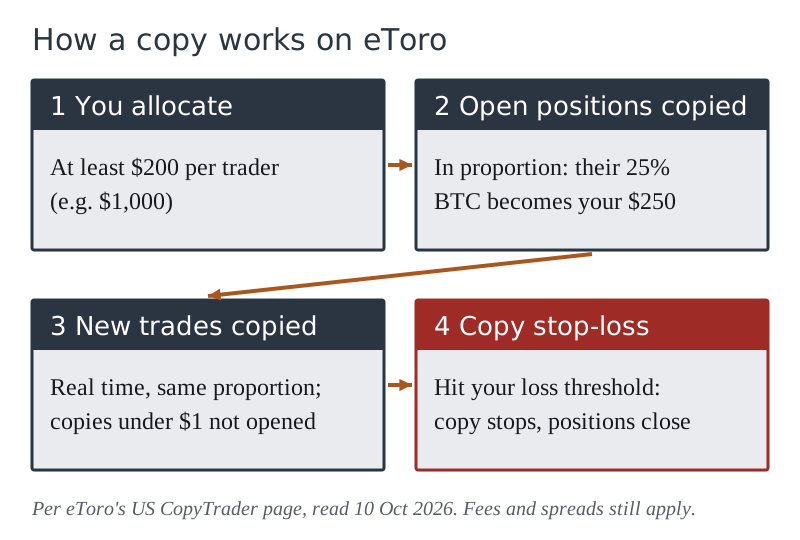
You can pause or stop a copy, add or remove funds, and set what eToro calls a loss threshold: if the copy loses that much, copying stops and the copied positions are closed. That copy stop-loss is the single most useful control in the product, because it caps how much one trader can cost you. It is still a market exit, so in a fast fall it closes at whatever price is available.
eToro also gives every account a $100,000 virtual portfolio. Copying a trader with play money for a month or two shows you their turnover, drawdowns and fee drag before any real money is involved.
Fees
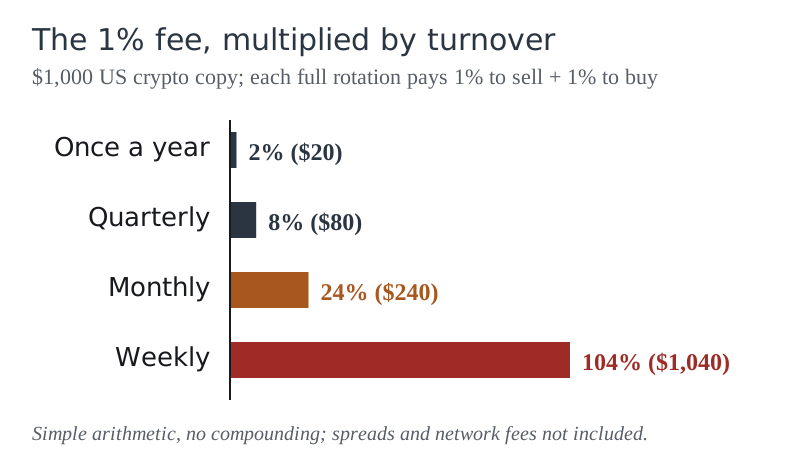
eToro's US page says there is no additional charge for using CopyTrader, and the next sentence carries the catch: "You will still be charged a 1% fee for crypto trading." eToro's US fee page explains that the 1% applies each time you buy or sell a cryptoasset and that, since mid-July 2025, it is shown as a separate line before the trade rather than folded into the spread. A copied crypto position therefore pays 1% when the trader buys and another 1% when the trader sells, on your money.
That makes the trader's turnover the main cost driver. The chart works through a $1,000 crypto copy. A trader who replaces the whole portfolio once a year costs about 2% in fees; one who rotates monthly costs about 24%; one who churns weekly would cost more than the entire allocation in a year. The arithmetic is simple and ignores compounding and spreads, but it shows why a high-return trader with high turnover can still leave copiers behind.
Other charges are smaller but worth knowing. eToro's US fee page listed a $0 withdrawal fee with a $30 minimum on 10 October 2026. Outside the US, eToro's international CopyTrader page says copying itself is free but that you "will still be charged spreads on the trading and/or transaction fees where applicable," and leveraged CFD positions carry their own costs.
Reading a trader profile: risk score, drawdown, track record
Every copyable profile shows returns, a risk score, drawdowns and the number of copiers. It helps to know what eToro itself requires of the traders it promotes. Its international page for the Popular Investor programme (which it now also calls the Pro Investor Program), read on 10 October 2026, sets entry standards that include a maximum daily risk score of 7, a maximum weekly drawdown no worse than minus 25%, profitable months at least 30% of the time, no single position above 50% of the portfolio, and at least two months of trading history.
Read those as floors, not quality marks. A trader who stays just inside them can still lose a quarter of the portfolio in a week, and two months of history says almost nothing about skill. When you look at a profile, the more telling numbers are the largest drawdown over the whole record, how long it took to recover, how often positions turn over (which drives your fees), whether the trader uses leverage, and whether the returns came from one lucky position. A long, dull record with modest returns and shallow drawdowns tells you more than a spectacular six months.
Why past returns mislead
Leaderboards are built from survivors. Thousands of people trade publicly; the ones with the best recent returns rise to the top, and the ones who blew up disappear from view. Some of the leaders are skilled. Many are simply the lucky tail of a large group, and the evidence from day-trading studies is that the skilled share is small: in Taiwan's market, fewer than 1% of day traders could reliably beat the market after fees.
Incentives add a second distortion. eToro's international programme page says it pays participants from the Champion tier upward "up to 1.5% of assets under copy," calculated on the average copied assets and paid monthly; Champion requires $50,000 of average monthly assets under copy. Copied money is the trader's revenue. That rewards gathering copiers, which in practice rewards eye-catching recent returns, whether or not the risk behind them suits the people copying. eToro's own disclaimer is the right summary: "Past performance of an etoro Community Member is not a reliable indicator of his future performance."
A leaderboard shows who did well recently. It cannot show who will do well next, or what risk they took to get there.
Availability by country
What a copy contains depends on where you live, and the differences matter more than the marketing suggests.
| Region | What copying involves | Key rules and warnings |
|---|---|---|
| United States | Crypto, stocks and ETFs; eToro's US fee page says crypto buyers own the assets. No extra copy fee; 1% fee on each crypto buy and sell; $200 minimum per trader. | CopyTrader is not available in all US states. Crypto trading is not offered in Nevada, Hawaii, Puerto Rico or the US Virgin Islands. Crypto holdings are not FDIC- or SIPC-insured, per eToro's US fee page. |
| United Kingdom | Copying through eToro's UK entity, which eToro lists as FCA-regulated. | The FCA has banned the sale of crypto derivatives, including CFDs, to retail consumers since 6 January 2021, so UK retail clients should not be offered crypto CFDs. |
| European Union | Copying through eToro's EU entity, which appears on ESMA's interim MiCA register of authorised crypto service providers. | Retail crypto CFD leverage is capped at 2:1 under ESMA's 2018 measures; providers must show their own loss rate. eToro's figure was 51% on 10 October 2026. |
For readers outside the US, the practical check is simple: before funding a copy, open a copied position in the app and see whether it is shown as the underlying asset or as a CFD. If it is a CFD, the leverage, overnight costs and the 51% warning apply to you.
Taxes on copied trades
Every trade a copy makes is your trade. For US taxpayers, the IRS treats crypto as property, so each copied sale or swap is a disposition that can create a gain or loss, and positions held a year or less produce short-term gains taxed at ordinary income rates. A busy trader can hand you hundreds of taxable events you never chose individually. Brokers report gross proceeds on Form 1099-DA. Our crypto trading taxes briefing covers the basics; it is not tax advice.
If you still want to try it
The safest version of copy trading is small, slow and capped. Start with the virtual portfolio and copy your shortlist with play money for at least a few weeks. When you move to real money, allocate an amount you could lose without consequence, set a copy stop-loss before the first trade, and prefer traders with low turnover, no leverage, long records and shallow drawdowns. Check the fee drag against the chart above, and stop copying anyone whose trading frequency you would not tolerate if you were placing the orders yourself. Our briefings on paper trading and managing risk if you trade apply directly.
If you go ahead, open the eToro CopyTrader page and read the terms for your country first. eToro's US disclaimer: "Use of the self-directed CopyTrader functionality does not constitute a recommendation or investment advice," and CopyTrader "is not available in all US states." eToro's international risk warning: "51% of retail investor accounts lose money when trading CFDs with this provider" (as displayed on 10 October 2026). Copy trading does not amount to investment advice, and your capital is at risk.
Edge cases
- The trader changes style. A cautious investor can start using leverage or concentrate the portfolio after you begin copying. Profiles show history, not commitments.
- You edit copied positions. Manually closing or changing positions inside a copy breaks the mirror and can leave your results far from the trader's.
- You add funds mid-copy. New money is invested at today's prices into the trader's current positions, not at the prices they paid.
- The trader stops trading. A copy of an inactive account just holds old positions; check copies regularly.
- State availability changes. eToro says CopyTrader is not available in every US state; confirm yours before you build a plan around it.
Risks and what can go wrong
Copy trading carries the trader's market risk, eToro's fees on every copied move, the platform risk of holding assets with a broker, and the behavioural risk of chasing whoever topped last month's leaderboard. Crypto is volatile and copied positions can fall to zero; outside the US, CFD copies add leverage. The copy stop-loss limits a single copy's damage but closes at market prices. This briefing is not financial advice. For the platforms we cover on fees, security and custody, see our platform comparison.
Common questions
Is eToro copy trading worth it?
How much money do you need to copy trade on eToro?
Does eToro charge for copy trading?
Is eToro CopyTrader available in the US?
Can you lose money copy trading?
Keep reading: the best crypto trading platforms, ranked on fees, security and custody, or, if you are new, crypto trading for beginners — risks first. None of this is financial advice.